I guess I've said what little I have to say on the subject of interactive fiction for the time being. This part of my blog is going on indefinite hiatus. If I get around to finishing a work of IF that incorporates some of my ideas, I may return, but that doesn't seem likely in the near future.
It has been a pleasure interacting with folks in the IF community.
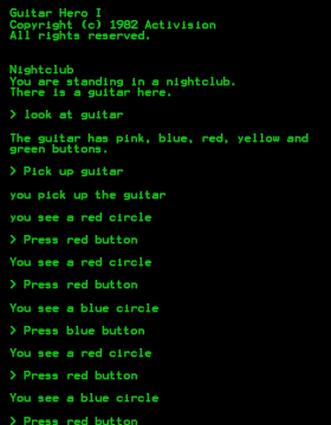
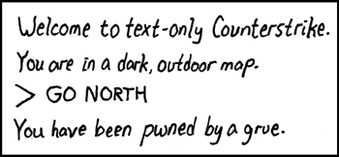
Most of you are familiar with the IF Arcade compilation – classic video games reimagined by IF. In my perambulations about the internet, I've come across a handful of more recent video games envisioned as IF, by non-authors. I imagine they were mostly created for their incongruous humor and a bit of nostalgia, by one-time fans of the medium who haven't played much IF since the '80s. Guitar HeroThis was originally just a "screen capture" posted by user ianwarren on the b3ta boards, but was subsequently made into an actual IF game by Bill Meltsner. Counter-StrikeAs seen on Randall Munroe's nerdy webcomic, xkcd.com. PortalA spot-on VHS-quality '80s "commercial" for Valve's Portal, complete with commercial buffers. It's unclear whether the creator was aware of Activision's 1986 interactive novel by the same name.
How do we entice new readers to IF? Unfortunately, I think a lot of existing IF isn't what the average reader is looking for. The characters and conflicts (such as they are in many IF titles) don't interest them, and learning to play requires too much effort, too many unfamiliar elements. Do we dumb it down? Cater to fans of popular genres? Most of us would die a bit inside at the prospect of typing KISS EDWARD into a Twilight IF fanfic. On the other hand, while I won't touch anything by Stephenie Meyer, I would definitely read an interactive young-adult vampire romance by Emily Short, because it would have complex characters with interesting interactions. But let's say we have a new "IF-lite" title that's catchy and reasonably easy to get into. How do we get readers to it? I think we can learn a bit from some other one-man creative enterprises with free or cheap products: webcomics, online novelists, and indie video game developers. The good ones all do a reasonable job of promoting their works on limited budgets. For example, indie gamers usually have a dedicated website or page for screenshots, videos, demo downloads, freebies, etc. Some examples would be yofrankie.org, afistfulofcows.com, and fiveminutemmorpg.com. Graphic novelists have the same sort of thing: wormworldsaga.com, and sevenextraordinarythings.com. The better online novelists' pages tend to be less visual, but still professional: davidwellington.net, craphound.com. Aaron Reed’s lacunastory.com is a start, but most IF writer websites look like they were designed by, well, writers. Also, in many of their cases, the site is the game, webcomic, or online novel. There’s no extra step, you click the ad or the link, and you’re playing the Flash game or reading the first comic or chapter. With Javascript parsers, this is now a cool possibility for IF as well. Digital delivery is a powerful thing, but it's hard to download "feelies," the physical objects that allured players to buy golden-age IF titles. However, we can offer similar enticements digitally. For example, James Patterson's young-adult Maximum Ride and Witch & Wizard series launched free iPhone apps that allow readers to take pictures "with" characters from the books, create wanted posters, and do personality quizzes, as well as read the first few chapters. Some iPhone CYOA titles have unlockable art. Echo Bazaar encourages social networking, and thus word-of-mouth/link. The right kind of IF game could incorporate a worldwide high score board, alternate reality gaming elements, or digitally tradeable aids and items — creating a sense of community and joint exploration. At the very least, we need good cover art. A quick search showed that most indie/free novels have pretty sad cover designs, so we're not alone, but readers do judge books by their covers, and if ours don’t even have one, or it’s clip art... Most IF titles also lack a good tagline or dust jacket blurb. We're not short on interesting and unique concepts, but we need to hook readers with them when they're browsing an IF database or a writer's website. The last time I was in an airport, I saw "trailers" for new novels playing on screens at the bookstore. They were mostly slide shows or details of the cover art, with title cards and a voice-over, but held my attention with audio/visual while pitching the book’s idea. I think there’s something to be learned there for promoting IF as well, even if it was just a good animated banner ad or something. Perhaps because of my background in advertising, a lot of these ideas use artwork. Graphics require hiring an illustrator or graphic designer, and maybe a web designer. But the aforementioned developers and writers budget for that, and IF like Floatpoint and Everybody Dies definitely benefits from having professional-quality illustrations. For the time being, interactive fiction is a non-paying market (with a few exceptions). But there are thousands of game developers, filmmakers, webcomic artists, novelists, bloggers, podcasters, composers, and entertainers that offer a free digital product, but promote it like they were selling it. They believe in their medium, and they're shooting for something bigger (a contract, living off ad and book sales, etc.). Interactive fiction has some of the most enthusiastic enthusiasts, but we need to convey that excitement to new readers if we're to entice them. [A while back, Jim Aikin asked about how to entice and reward players of IF. This post is my thoughts on enticing, and I hope to write more on rewarding in a later post.]
Harry Potter. The Da Vinci Code. Twilight. I predict that during my lifetime someone will write the new popular bestseller, but it will be digital and interactive. It won't have a command prompt, but it won't just be CYOA, either. People will read it on their browsers, Kindles, and iPhones (or whatever we use by then), and it may involve graphics, social networking, limited interaction with other readers, but it will read more like a novel than a game. It could be released as a normal series, or open-ended and constantly updated, like Echo Bazzar, and fans will form communities around debating every possibility and ending, each backstory, all secret areas. Interactivity is this new generation's native language, and I think it's inevitable that the fiction they read becomes individualized, networked, and always-on.
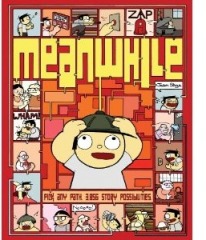 I commented on the absence of minorities in GET LAMP, but forgot the brief interview with the one person I actually recognized: Asian-American cartoonist Jason Shiga. Jason talked about children enjoying CYOA books because they don't get many choices in real life, and there's definitely a child-like exploration and fantasy to many of his works — as well as a vindictive and violent hand of Fate. Also, Jason has a mathematics degree from UC Berkeley, and his mathemagical brain clearly informs the different formats of his interactive comics.I consider Meanwhile his magnum opus so far. You can read a black-and-white online version of it at his site. I bought the original xeroxed and hand-cut version, but you can apparently only get the commercial full-color print version from Amazon.com now, which I haven't seen. He also created a giant poster of it. Meanwhile is a brilliant interactive use of the spatial medium of comics — instead of necessarily reading left-right, top-bottom, you follow tubes between panels, which sometimes branch at choices, and often lead off the page on to a tab which you must flip to. The first choice is between vanilla or chocolate ice cream, but you quickly realize that Shiga is able to transcend the CYOA medium with ironically mirrored events, unsettling discoveries, and a story that explains quantum physics even as the tube structure mimics the concepts presented. Here's Jason with a brief explanation of his book:
Check out Jason's site, shigabooks.com, to see online versions of some of his comics. I recommend his interactive The Last Supper, The Bum's Rush, and April Fooled, and his more traditional Bookhunter and Fleep. Unfortunately, another of his full-length interactive works, Knock, Knock, isn't even mentioned (apparently out of print). It's incredibly ambitious: the main character is trapped by a killer in a room full of objects to be interacted with in any order, and all the possible three-choice sequences are drawn out — but only one leads him outside to safety and the shocking reveal. Here's a video review if you want to see more of Meanwhile. And a 2004 video interview that shows more of his work. If all this makes you want to make your own interactive comic, Jason explains how to fold a short branching booklet (and demonstrates a few of his comics):And for those who dislike CYOA books because they don't track variables, Jason has Hello, World, a "programmable" comic that tracks inventory choices in a split layer of the book:
I've added another page to my site for stuff I like or want to talk about that's not related to interactive text. It's under the "Cool Stuff" link in the header. Technically this post belongs over there, but whatever.
Happy Thanksgiving!
My wife and I were thinking of entertainment options besides watching a DVD and that didn't involve going out. We finally hit upon playing an interactive fiction game together. She's never tried IF, and I wanted to experience something new to both of us, so we tried Rover's Day Out, winner of the 2009 Annual Interactive Fiction Competition .We played for over an hour, and got about halfway though it, I estimate. I typed, and she suggested actions when we were figuring things out, and we had a good time. She caught on very quickly, even to Rover's unusual framework, and learned to skip the room descriptions and other repeated text and read just the new information. I'd meant to be a bit more scientific, and give her a title to figure it out on her own while I watched, to see how someone would approach IF having no background. However, this was actually enjoyable for both of us, and hopefully we'll finish Rover's, and many other titles in the future together. And, yeah, I'm bragging a bit that I have a wife who'll play IF with me.
I just finished Jason Scott's IF documentary GET LAMP. - After the intro, I thought, "Wow, an old computer turning on, then a bunch of old guys talking about caves. That'll keep 'em on the edge of their seats!" I suppose this isn't meant to be marketing or evangelism, but it still could have opened with a hook.
- IF people are very articulate (and the interviews were well edited). Often these documentaries include a lot of gushing and undirected verbiage, but not with this crowd. As Brian Moriarty said of early IF, it had a "friendly, smart-people feel about it."
- Were blind players the only minority in the documentary? Not a criticism, just interesting that it falls out that way.
- GET LAMP made the point that early IF provided an immersive experience under tight technological constraints. In fact, that is part of why it was financially successful and even drove computer sales: interactive text was much deeper than the simple games and graphics of the times. And as Richard Bartle argued, text coupled to our imaginations will always be superior to any hardware. Early IF authors innovated around their constraints to accomplish as much as possible. Some of it worked, some didn't, but they kept trying. It's been said that necessity is the mother of invention, and that constraints can fuel creativity. I sort of feel that since hardware limitations have been removed, IF has been content to stagnate, ignoring the restrictions of market forces, reader demographics, streamlined interfaces, etc.
- The interviewees seemed pretty convinced that puzzle is the enemy of story, at least for modern readers. On the other hand, solving good puzzles in IF is an experience unparalleled in almost any other medium, and IF junkies will keep chasing that 'aha!' high. But it seems new players need a gateway drug.
GET LAMP was very well done, and I enjoyed it, even the reminiscing about about early computers (I goofed around on my folks' TRS-80 when I was seven). I had hoped it would be a catchy introduction to the medium, but liked it for what it was, and it should hold up well for future audiences.
Choose-your-own-adventure books are often slighted by the IF community for their simple branching structures and lack of true interaction/world modeling. Fair enough, but I think interesting stories can still be told in this semi-static medium, and each of the following games is notable for its presentation or story. Thousand Dollar SoulA sci-fi story that is deeper (and creepier) than it first appears. You'll have to play through several of the 35 endings to piece the whole picture together. The interface allows you to back up as much as you want.Air PressureA visual novel about a relationship with a needy friend. Or is it? The OutbreakAn interactive zombie survival movie. It has the usual limitations of interactive movies, plus horror movie clichés, but does some clever things with a few branches, and dying is as fun as winning. Dead Frontier: OutbreakDead Frontier: Outbreak 2Two zombie apocalypse choose-your-own-adventures, with music, voice-over, and background graphics. Click to skip through text.Choice of DragonChoice of BroadsidesChoice of RomanceChoice of the VampireThese are the best written on this list, and mechanically interesting as well. Each game tracks attributes for your character's choices, and the story changes based on your attributes, sometimes in substantial ways. While I'm not usually a fan of the genres they chose, all but Vampire got me hooked. It is in itself notable for the broad scope it attempts, though it ultimately fell short of a good story, in my opinion.
At AdventureDevelopers.com, Beiddie Rafól has written a feature called The Cold Hotspot. The Adventure Developers site is geared toward graphical adventures, and the feature's four articles ( 1, 2, 3, and 4) discuss the fallen state of once-popular adventure games, and possibilities for the future. According to Rafól, there are almost no commercial adventure releases and he describes a vicious cycle of unwillingness to change format or content, poor market research, ineffective advertising, and lack of financial success or backing. He mentions a cluster of recent or in-development titles as bright spots in a dimmed corner of the gaming market, and hopes they and yet-future adventure games will attract the growing segment of gamers who want to think and discover instead of twitch and destroy. The feature was written in 2005.As you can tell (or already knew), graphical adventures and IF have a lot in common as mediums: an early form of computer game, once popular and commercially successful, now virtually unknown in the PC and console market, even if you define them more broadly than purists insist upon. And IF is even farther behind adventure games in brand recognition, commercial success, and inflexibility in the face of today's market forces. I'm sure articles similar to Rafól's were also being written about IF five years ago. Since then, the gaming industry has continued to boom. The number of casual gamers has increased dramatically. The fiction market is still huge. This generation reads and links copious amounts of digital text in e-books, websites, blogs, forums, comments, social networking, IM, and texting. Yet adventure games and IF continue with virtually zero market share. What gives?
I'm familiar with several mediums of interactive text, but it seems each is stereotyped by outsiders. In some cases, the stereotypes are fairly accurate of what has been done in that medium up until now. However, I believe that none of the mediums are as flawed as they are made out to be, just that new works in each tends to be like previous works, forming flawed genres within the medium. Here are the stereotypes as I perceive them: Choice-based fiction (CYOA). "Adventure or fantasy genre, written for teens. Arbitrary choices, most of which lead to death. 'Lawnmowering' through each choice branch to find content or endings." Interactive fiction. "Ugly text. Funky command line interface. 'I don't understand that command.' Examine everything, pick up everything, try everything." Graphic adventures. "Over-clever dialogue and descriptions, self-referential or in-joke humor. Illogical puzzles. Fetch quests and favor trading. Examine everything, pick up everything, try everything with everything." Tabletop RPGs. "Fantasy genre. Lots of dice. Nerds in their moms' basements, arguing about whether a Level 14 Elf Mage could actually go two weeks without pooping if he ate only lembas wafers." MMORPGs and MUDs. "Same as above, but in leetspeak." Video game RPGs. "Fantasy genre. Unite the 12 Lightshards of the Everglow to defeat Horribus McDarknasty. Fetch quests and favor trading. Grinding. Menu-choice dialogue, and people standing around saying '...' to each other." Hypertext. "Artsy-fartsy 'literary' writing. Passages joined by link spaghetti. No progress or ending." Visual novels. "Visual what?" Video games. "BOOM! BOOBS! THREE DIFFERENT ADRENALINE-DRENCHED ENDINGS!" Most of these could be lampooned indefinitely, but I think that generally covers it. Comment if there's a medium I left out. Obviously, I stereotyped these so as to make my point, but I do think most people's objections to an interactive text medium lie with the genres it has become associated with, not with the medium itself. Fans of IF might complain that CYOA has no world model, only a pruned branching structure, but I think if an interesting story with developed characters were written as a choice-based novel for a good reason, they could appreciate it as much as a static novel (still wouldn't scratch their IF itch, I understand). Similarly, it's not that IF outsiders aren't interested in fiction set in a fully-modeled text world, they just aren't interested in ones about "you" having to pick up everything, etc. (and maybe not interested in learning the command line interface, though I argue IF can be defined more fundamentally than that). Many complain that mainstream video game titles are just carbon copies of each other with the newest graphics and hardware. But the truth is, each kind of interactive text is almost as locked into their genres and types – and the game engines and input methods haven't updated since the 70s. I think each of these mediums could learn and borrow from some of the others to create an attractive experience for new readers and players. Some examples already attempting this: Jeepform RPGs like A Bitter Aftertaste that create a literary narrative, similar to improv theater; Sweet Agatha, a book that is physically taken apart and told interactively to a listener; and Choice of Games CYOA stories, written in several unusual genres, with interesting informed choices and personality stats that affect gameplay. Not everything will work, but if what we're doing now isn't as successful as we'd like (for whatever definition of success), it's time to try something new – and why not start with popular elements from other mediums?
I'm sure more-qualified people have discussed this more intelligently, but I never let that stop me before... There are notable works written in second-person narrative, but the majority of fiction is written in first- or third-person. And while readers can identify strongly with the second-person form, most find it jarring and forever associated with cheesy choose-your-own-adventure books. Yes, this is just a convention, and obviously long-time IF readers think nothing of being told how they feel, act, and react, but it seems the average reader doesn't want to make the jump. I suspect that as long as interactive works are written in the second-person, most new readers will be turned off. One problem with the protagonist of a story being "you" is that either the writer characterizes "you" with interesting details which likely clash with your real reactions and specifics, or the writer omits them for you to fill in, creating a bland "cipher" protagonist. With good first- and third-person fiction, the protagonist is unique and compelling, perhaps wildly different from the reader, but someone they can identify or sympathize with. Why isn't more interactive fiction written in the first- or third-person? I'm interested to hear what people think on this, and what notable non-second-person interactive texts are out there.
 I got really sick once as a kid, and my folks bought me a choose-your-own-adventure book. I loved it and checked more out from the library, but soon saw a pattern: the choices presented rarely gave me any idea of their outcomes, too many choices ended in me dying, and others led to the same place and so were no decision at all. That lessened it for me, and since all I could find were adventure CYOA books, I soon got sick of them and read other things. About a decade later, I discovered interactive fiction. Ditch Day Drifter was one of the first, and I really enjoyed the puzzles and exploration. However, after playing a few titles, I found that I was punished with unsolvable roadblocks if I didn't methodically explore and probe everything, but I was also punished with "I don't understand" and "You can't do that" messages if I experimented too much. And who ever read a story with the sentence "There is a box (empty) here"? Or one that made me type "kaleidoscope" correctly 17 times to read to the end? Or told me there were seats in the car, but when I tried to LOOK UNDER SEATS told me I could see no such thing here, and after I realized I needed to look under one SEAT, said " Which do you mean, the seatbelt, the driver's seat or the passenger's seat?"
I still play IF, of course. But I'm not surprised that few people are attracted to it these days, and are content with the cliched interactivity of video game plots or CYOA books. At least those don't talk weird and interrupt the story all the time...
Recently there's been a lot of talk about attracting new readers to IF, especially given the huge markets of casual readers (print and digital) and casual gamers.
Is the solution to change IF itself? If so, how? Just mention modifying the interface, and IF diehards act like you're going to hack into ifarchive.org and remove the command prompt from every file.
What about some sort of hybrid to bridge readers from CYOA to IF?
Or is there a more fundamental solution? In 1975, the creator of Adventure ingeniously designed around computer processing and memory limitations to create an enjoyable experience. These days we're no longer limited by hardware – our constraints are the tastes and habits of today's readers and players. With the expertise of 35 years since Adventure, can we start from those limitations and create a new enjoyable experience? One that's as fun as reading a book, as familiar as browsing a blog, but as robust as exploring Ditch Day Drifter?
Recently Emily Short [ twice], David Cornelson, Nick Montfort, and others have written about the command line/parser in traditional IF, and whether we can improve or eliminate it. Understandably, when a player tries IF for the first time, they are usually confused by the command line and the many conventions that go with it. They end up with more error messages than story, and are unlikely to persist. The command line will live on as long as authors and readers keep enjoying fiction made with it. But many have pointed out there is a huge market of readers (print and digital) and casual gamers who ought to love all this free IF, but sadly, they aren't exactly flocking to it. One reason must be the interface. Another might be the lack of "packaging," both in a marketing sense (few attention-grabbing covers, promotional materials, or sites), and a convenience sense (first download an interpreter, then a file, then find a FAQ or guide). A third for some is that playing IF can feel like using DOS or an early BBS, not reading a book. And if a reader gets past all of these things, they're likely to find most IF is about "you," trapped in an area, examining everything and picking up random things to get to the next area. Obviously, there are exceptions to all of these, but a beginner can't count on finding them before giving up. I tried to address some of these barriers, and below are mock-ups of my ideas. They fit an iPhone screen, and could be programmed in Javascript to work on mobile devices and browsers. The images are a sequence: the result of each click is shown on the next screen. Click on images to see a larger version in another window/tab. Firefox and others may shrink the image to fit that window, you should be able to click it for full size. Verb icons. Click the verb icon you want to perform, then the word in the text you want to perform it on. The main description and story carry on in the top bar (reflecting any changes you make to them), and immediate responses to your actions show at the bottom. For a working example, see my unfinished story Red. The way this mock-up turned out, it seems like it would be good to have both a TALK TO and a TALK ABOUT (with whomever you're currently speaking to) icon. And maybe a GO TO icon. Inventory. This version leaves its transcript available as grayed text, and only disables links that would break the game (e.g. players can't pick up the same object twice). You can see an example of this method by I.D. Millington at undum.com. My mock-up also has an inventory, and works somewhat like point-and-click Flash games: clicking on an object in the text either interacts with it or adds it to your inventory, and objects in your inventory can be examined and combined, or used on yourself or things in the description text. As my simple example tries to show, this would allow for some lateral thinking puzzles. One cumbersome part of the transcript method is having to scroll back for keywords you need, hitting the eye icon to look at the room again, and re-clicking objects for description keywords Popup menus. The links look just like the rest of the text, and the reader just clicks on nouns or significant phrases to view and choose from interaction options. This would keep the text "clean" and require no extra panels, but almost everything in the text would need a menu to come up when clicked.
I've shown two styles, the first more of a choose-your-own-adventure flavor, the second more IF puzzle solving. Either would allow you to examine objects and their details, but also manipulate them or make choices that moved the story.
I showed only verbs that served my examples, but the menus could be more consistent, offering the same limited set of verbs minus inapplicable ones based on context (e.g. no TASTE option for the moon). The menus could also use verb icons instead of words.
Inventory + verbs. No mock-up for this one, but it would work as a combination of the first two examples, like a LucasArts graphical adventure such as The Secret of Monkey Island. The player chooses from a list of verbs, and performs them on links in the text or items in the inventory list. Add directional buttons, and you could have most of the interactions of IF or graphical adventures.
Granted, it's fairly easy to create short mock-ups that serve my purposes. These may look like glorified CYOA games to some. The proof will be to create a working story that provides an enjoyable experience. I believe that with some extra work (programming all by hand, without the benefit of a robust environment like Inform or TADS), one could create a fiction system that allows free travel, object manipulation, and puzzles, while still being intuitive and book-like to new readers.
|



 RSS Feed